
Scaling up the Quality of Care Project in China
Quality of Care Project History:
In 1995 the National Population and Family Planning Commission (NPFPC)
of China began to reorient its family planning program towards greater
quality of care. Between 1995-2000 quality-of-care pilot projects were
initiated in 11 counties. The package of innovations introduced included:
broadening informed choice in contraceptive decision making; changing
the content of information, education and communication (IEC) materials;
improving provider-patient relationships and technical competence; and
expanding family planning services to include other aspects of reproductive
health care.
Scaling-up efforts:
In 2000 the National Population and Family Planning Commission began
to scale up quality-of-care innovations to the whole country. In 2002
the Family Planning Law was passed which affirms the principle of informed
choice and criminalizes coercion in family planning. Since 2002 the Commission
annually selects a number of “advanced counties” which meet
its 33 quality-of-care indicators. The scaling-up efforts receives technical
support from the Operational Office of the Quality Project which is located
at the China Population and Development Research Center funded
by the Ford Foundation.
In March 2005 a workshop organized by the Operational Office held in
the Changping District of Beijing, concluded that a guide on quality
of care was needed. The purpose of this guide would be to assist new
counties in carrying out quality-of-care improvements and to serve as
a training resource for staff of the Operational Office. Key staff members
from pilot counties had the opportunity to provide input during the guide's
development. To complement the guide a two-day training curriculum was
developed.
In 2005 and 2006 the guide and training curriculum were pre-tested with
approximately 260 county and prefecture participants in Jiu Jiang Prefecture
of Jianxi Province, and Anshun Prefecture of Guizhou Province. Participants
found the training and guide useful; valued learning from the experiences
of the pilot counties and felt the guide provided new information about
the concept of quality-of–care.
Future Efforts:
The Operational Office hopes to create a group of master trainers at
the provincial level who are committed to (1) implement cascade training
for all counties in the province (2) provide a copy of the guide to all
counties/townships in the province, (3) conduct a systematic review of
what changes are needed to enhance quality of care and, (4) provide periodic
reports on what progress has been made to the Operational Office.
The Operational Office also hopes to (1) advocate at the national level
for additional measures to institutionalize quality-of-care and facilitate
its implementation at the provincial and county level, (2) follow-up
and disseminate results from scaling-up initiatives; and (3) participate
in
the design of future innovations in the areas of gender, sexuality, adolescents,
men, and violence against women.
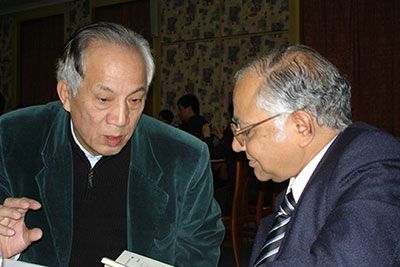
At right is a short video clip of the
Director of the Quality Project Operational Office conveying the
content of a poster in a county-level family planning clinic that
describes key points about quality of care.
Please click the arrow
to play. |
|
Further reading:
Kaufman,
Joan, Zhang Erli, Xie Zhenming. Forthcoming. "Quality
of care in China: from pilot project to national programme" In:
Simmons R, Fajans P, Ghiron L, eds. Scaling-up
health service delivery: from pilot innovations to policies and programmes.
Geneva, World Health Organization. (Book available in PDF by
clicking title)
"Quality
of Care in Family Planning: Pilot Experiences in China".
2007. National
Population and Family Planning Commission, Quality of Care Project Operational
Office.
Website of the Quality of Care Project at www.fpqoc.org.cn.
|